Are Credit Unions Declining Members Because They Don’t Have Enough Data?
Every credit union has lending policies designed to establish where it is comfortable extending credit, based on its risk appetite, portfolio strategy, regulatory responsibilities, and understanding of its membership. But every lending decision is also shaped by the information available at the point that decision is made.
For some Members, traditional credit data provides a detailed and well-established financial picture. For others, particularly those with limited credit history, multiple sources of income, changing employment patterns, or less conventional financial profiles, that picture can be incomplete.
This raises an important question for credit unions focused on both responsible loan growth and Member access to credit: How many Members who are declined today might fit the credit union’s existing risk appetite if the institution had a more complete financial picture at the point of decision?
Additional permissioned data can provide greater context around income, cash flow, financial obligations, and financial behavior. Used appropriately, that information can strengthen the lending process without requiring an institution to replace the underwriting models, policies, or decisioning systems it already relies on.
A decline reflects the information available at the time
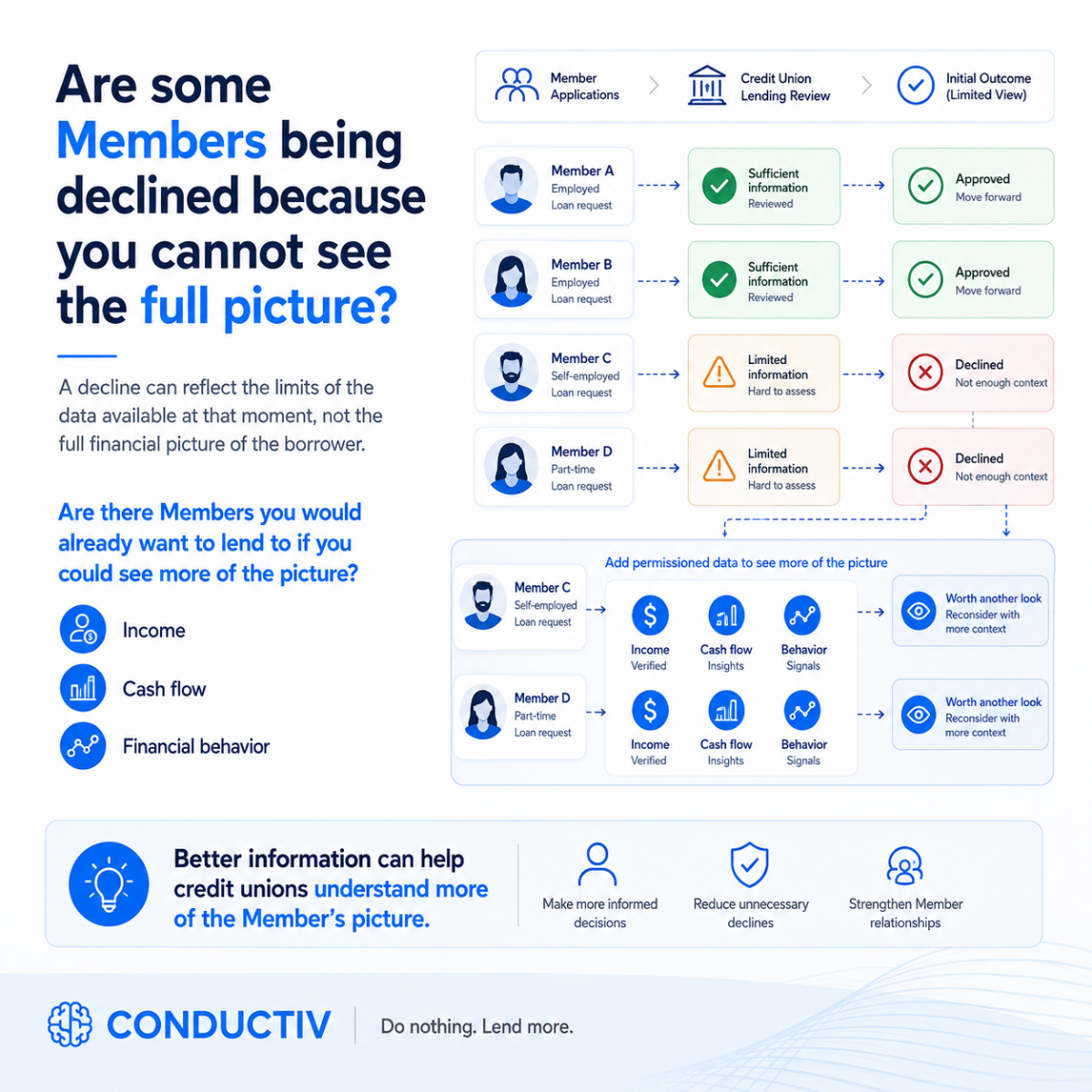
Every credit decision is based on a collection of signals. Credit history, debt obligations, stated income, employment information, loan-to-value, debt-to-income ratios, internal lending policies, and other factors all contribute to the eventual outcome.
The depth of information behind those signals, however, can vary considerably from one Member to another. A Member with a long credit history, conventional W-2 employment, and established borrowing relationships is likely to produce a relatively rich traditional data profile. Another Member may earn sufficient income and manage their finances responsibly while having a much thinner credit footprint. They may be self-employed, work across several income sources, primarily use debit rather than credit, or simply have limited previous borrowing history. Limited conventional credit information does not necessarily provide a complete view of that Member’s ability to repay. (Read more about why user permissioned income verification outperforms traditional methods.)
FinRegLab has estimated that approximately 20% of U.S. consumers lack sufficient credit history to predict their repayment risk using conventional scoring models. Its research into cash-flow underwriting also highlights the potential value of transaction information in providing a more detailed picture of how an applicant manages their finances over time.
For credit unions, this can create a meaningful gap between Members who fall outside lending criteria because of genuine credit risk and those who are harder to assess because the available data is incomplete.
What is cash flow underwriting?
Cash flow underwriting uses information about the money moving into and out of an applicant’s accounts to provide additional context around their financial position. Depending on the data available and the institution’s policies, this can include signals relating to:
Income and income consistency
Recurring deposits
Account balances
Expenses and financial obligations
Cash-flow patterns over time
Multiple or nontraditional income sources
Changes in financial circumstances
Cash-flow information can be used alongside traditional credit data, providing an additional layer of context where conventional information alone does not tell the full story. For Members whose financial circumstances are difficult to interpret through traditional credit data alone, that additional context can be hugely valuable.
What is permissioned data in lending?
Permissioned data is financial information that a Member explicitly authorizes a lender to access. Rather than relying solely on information contained in a credit report or documents manually submitted during an application, a Member can grant access to relevant financial data, such as bank account or payroll information. This can give the credit union access to more current information about income, cash flow, and financial activity while giving the Member visibility and control over the information being shared. The practical value comes from making that data available inside the lending process at the point where it can inform the institution’s existing underwriting and decisioning approach. Learn more about permissioned data for lending.
The role of second-look lending
This is where second-look lending becomes particularly relevant.
A second-look process gives a financial institution an opportunity to consider additional information for an applicant who does not initially meet conventional approval parameters.
Federal regulators have specifically acknowledged this approach. Interagency guidance describes how financial institutions may use alternative data for applicants who would otherwise be denied credit, referring to these as “Second Look” programs. When implemented responsibly and in line with applicable consumer protection requirements, the agencies note that these programs may improve access to credit.
For a credit union, a second look can provide a structured way to determine whether additional information could clarify an application before a final outcome is reached. Consider a Member whose application falls just outside established approval parameters. Traditional data may provide one view of that Member. Permissioned income or transaction information may add further evidence around income stability, the consistency of deposits, current financial commitments, or how the Member manages cash flow. The additional data does not determine the lending decision. It gives the credit union more context on which to base that decision.
Can credit unions approve more loans without changing their underwriting models?
In some cases, they may be able to identify more qualified Members by improving the information available to their existing underwriting processes. Credit unions have invested significant time, expertise, and governance in developing lending policies, scorecards, decisioning strategies, and risk models that reflect their membership and risk appetite. Additional permissioned data can be introduced as another input into that existing framework.
For example, an application may reach a point where the data initially available is insufficient to satisfy an approval parameter. Rather than ending the process there, the workflow can determine whether an approved additional data source can provide greater clarity. That could include verified income, transaction or cash-flow information, employment data, or other relevant financial signals.
Where the additional information strengthens the credit union’s understanding of the Member, the institution may be able to make a more informed decision without materially changing its established credit policy. This is particularly relevant for credit unions looking to grow lending while maintaining appropriate risk discipline.
Thin-file Members show where traditional data can fall short
Thin-file and credit-invisible borrowers provide a clear example of the limits of conventional credit information. Credit history tells an institution how someone has historically managed credit. It provides less visibility into aspects of financial behavior that may not appear on a credit report.
A Member may receive reliable income, maintain appropriate account balances, meet regular financial commitments, and demonstrate consistent financial behavior while still having relatively limited borrowing history. Additional financial information can provide useful context in these circumstances, particularly when it relates directly to income, expenses, and the ability to meet recurring obligations.
For credit unions, this aligns closely with the relationship-led nature of the institution. Many credit unions know considerably more about their Members than a conventional credit file can communicate. The opportunity is to make more of the relevant financial information available within a consistent, scalable, and appropriately governed lending process.
Better lending data can also improve the Member experience
Incomplete information creates friction for the lender, but it can also create friction for the Member. When the lending process cannot access the information it needs, the Member may be asked to locate pay stubs, provide statements, upload documents, explain income sources, or respond to repeated requests for additional information. These steps add effort and can slow the application process. Permissioned data can reduce some of that burden by allowing relevant information to be obtained directly, with the Member’s authorization, and incorporated into the lending workflow.
For credit unions, this can support a more efficient process while reducing unnecessary document collection and manual reconciliation. For Members, it can mean fewer steps between application and decision.
The quality and relevance of the data still matter
Access to additional information only creates value when the data is relevant, appropriate, reliable, and used within the institution’s compliance and governance framework. The aim is therefore to improve the completeness and usefulness of the information supporting a credit decision. Data should help answer questions that are material to underwriting and should be available at the point where it can contribute meaningfully to the decision. That creates a broader operational challenge: bringing together information from multiple sources and making it usable inside the lending systems the institution already relies on.
Data orchestration makes additional context usable
Permissioned consumer data, internal Member information, application data, income and employment information, transaction data, traditional credit information, and third-party sources of data can all provide credit unions with valuable signals. The difficulty is connecting those sources in a way that supports the lending process without creating additional manual work or fragmented workflows.
Data orchestration allows relevant information to be aggregated and operationalized within existing lending infrastructure. For many credit unions, this means improving the quality and completeness of the information flowing into established loan origination, underwriting, scoring, and decisioning processes rather than introducing another standalone system for lending teams to manage.
How Conductiv helps credit unions build a more complete lending picture
Conductiv helps credit unions access, aggregate, and operationalize relevant lending data within their existing workflows. By connecting internal application and Member information with permissioned consumer data and relevant third-party sources, Conductiv can help create a more complete view of an applicant at the point of lending.
Conductiv complements existing scoring and decisioning systems by improving the data available to them. Credit unions can therefore introduce additional context while retaining the underwriting policies, processes, and risk frameworks they already have in place.
For some applications, additional information may reinforce the initial lending outcome. For others, it may provide enough context to show that a Member fits comfortably within the institution’s existing lending appetite.
For lending leaders, the question is worth considering:
How many Members who are declined today might already be good lending candidates if the institution could see more of their financial picture?
Frequently asked questions
What is second-look lending?
Second-look lending is an approach in which a lender considers additional information for an applicant who would otherwise be declined under the initial evaluation. Federal regulators have specifically referenced the use of alternative data for this purpose, while emphasizing the importance of compliance with applicable consumer protection requirements.
How can permissioned data help credit unions make better lending decisions?
Permissioned data can provide additional, current information about a Member’s income, cash flow, and financial activity. When incorporated into existing underwriting workflows, it can give lending teams and decisioning systems greater context without requiring the institution to replace established credit models.
Does cash flow underwriting replace traditional credit scores?
No. Cash-flow information can complement conventional credit data by providing additional insight into income, expenses, balances, and financial behavior over time. Federal regulators have recognized cash-flow information as one potential form of alternative data that can be incorporated into established underwriting practices.
Can a credit union use additional data without changing its underwriting model?
Yes. Additional data can be introduced as another input into an institution’s existing lending process. This allows the credit union to improve the information available to its scorecards, policies, and decisioning systems while retaining its established approach to underwriting.
Why is cash-flow data useful for thin-file borrowers?
A thin credit file provides limited information about a Member’s historical use of credit. Cash-flow information can provide additional insight into income consistency, expenses, and how the Member manages their finances over time, helping provide context where conventional credit information is limited.
How can credit unions approve more qualified Members while maintaining appropriate risk controls?
A stronger starting point is improving the quality of information available at the point of decision. By using relevant additional data to understand applicants who sit outside initial approval parameters, credit unions may be able to identify Members who fit their existing risk appetite but are difficult to assess using the original data available.